How Boris Cherny Uses Claude Code
Boris created Claude Code at Anthropic. When asked how he uses it, he shared 13 practical tips from his daily workflow. His setup is "surprisingly vanilla" — proof that CC works great out of the box.
@bcherny's January 2, 2026 threadBoris runs 5 instances of Claude Code simultaneously in his terminal using 5 separate git checkouts of the same repo. He numbers his tabs 1-5 for easy reference and uses system notifications to know when any Claude needs input.
Beyond the terminal, Boris runs 5-10 additional sessions on claude.ai/code. He fluidly hands off between local and web using the & command or --teleport flag.
He also kicks off sessions from his phone via the Claude iOS app in the morning, then picks them up on his computer later.
& — Background a session--teleport — Switch contexts between local and web
Boris uses Opus 4.5 with thinking mode for every task. His reasoning:
The takeaway: less steering + better tool use = faster overall results, even with a larger model.
View original postThe team shares a single CLAUDE.md file for the Claude Code repo, checked into git. The whole team contributes multiple times a week.
During code review, Boris tags @.claude on PRs to add learnings to the CLAUDE.md as part of the PR itself.
They use the Claude Code GitHub Action (/install-github-action) for this. Boris calls it their version of "Compounding Engineering" — inspired by Dan Shipper's concept.
Most sessions start in Plan mode (shift+tab twice). Boris iterates on the plan with Claude until it's solid, then switches to auto-accept mode.
"A good plan is really important to avoid issues down the line."
View original postBoris uses slash commands for workflows he does many times a day. This saves repeated prompting, and Claude can use them too.
Commands are checked into git under .claude/commands/ and shared with the team.
Boris thinks of subagents as automations for the most common PR workflows:
verify-app — Detailed instructions for end-to-end testing
The team uses a PostToolUse hook to auto-format Claude's code. While Claude generates well-formatted code 90% of the time, the hook catches edge cases to prevent CI failures.
Instead of --dangerously-skip-permissions, Boris uses /permissions to pre-allow common safe commands. Most are shared in .claude/settings.json.
Claude Code uses all of Boris's tools autonomously:
- Searches and posts to Slack (via MCP server)
- Runs BigQuery queries with bq CLI
- Grabs error logs from Sentry
For very long-running tasks, Boris ensures Claude can work uninterrupted:
(b) Use an agent Stop hook for deterministic checks
(c) Use the "ralph-wiggum" plugin (community idea by @GeoffreyHuntley)
For sandboxed environments, he'll use --permission-mode=dontAsk or --dangerously-skip-permissions to avoid blocks.
This is Boris's #1 tip:
For his own changes to claude.ai/code, Claude uses the Claude Chrome extension to open a browser, test UI changes, and iterate until it works perfectly.
Verification varies by domain: Bash commands, test suites, simulators, browser testing, etc. The key is giving Claude a way to close the feedback loop.
More Tips from Boris Cherny
Boris shared 10 more tips on January 31, 2026. These are sourced directly from the Claude Code team — remember, everyone's setup is different. Experiment to see what works for you!
@bcherny's January 31, 2026 threadSpin up 3-5 git worktrees at once, each running its own Claude session in parallel. It's the single biggest productivity unlock, and the top tip from the team.
Some people also name their worktrees and set up shell aliases (za, zb, zc) so they can hop between them in one keystroke. Others have a dedicated "analysis" worktree that's only for reading logs and running BigQuery.
Pour your energy into the plan so Claude can 1-shot the implementation. Don't keep pushing when things go sideways — switch back to plan mode and re-plan.
They also explicitly tell Claude to enter plan mode for verification steps, not just for the build.
After every correction, end with: "Update your CLAUDE.md so you don't make that mistake again." Claude is eerily good at writing rules for itself.
One engineer tells Claude to maintain a notes directory for every task/project, updated after every PR. They then point CLAUDE.md at it.
Create your own skills and commit them to git. Reuse across every project.
- If you do something more than once a day, turn it into a skill or command
- Build a /techdebt slash command and run it at the end of every session to find and kill duplicated code
- Set up a slash command that syncs 7 days of Slack, GDrive, Asana, and GitHub into one context dump
- Build analytics-engineer-style agents that write dbt models, review code, and test changes in dev
Enable the Slack MCP, then paste a Slack bug thread into Claude and just say "fix." Zero context switching required.
Or, just say "Go fix the failing CI tests." Don't micromanage how.
a. Challenge Claude. Say "Grill me on these changes and don't make a PR until I pass your test." Make Claude be your reviewer. Or, say "Prove to me this works" and have Claude diff behavior between main and your feature branch.
b. After a mediocre fix, say: "Knowing everything you know now, scrap this and implement the elegant solution."
c. Write detailed specs and reduce ambiguity before handing work off. The more specific you are, the better the output.
The team loves Ghostty! Multiple people like its synchronized rendering, 24-bit color, and proper unicode support.
For easier Claude-juggling, use /statusline to customize your status bar to always show context usage and current git branch. Many of us also color-code and name our terminal tabs, sometimes using tmux — one tab per task/worktree.
a. Append "use subagents" to any request where you want Claude to throw more compute at the problem.
b. Offload individual tasks to subagents to keep your main agent's context window clean and focused.
c. Route permission requests to Opus 4.5 via a hook — let it scan for attacks and auto-approve the safe ones.
Ask Claude Code to use the "bq" CLI to pull and analyze metrics on the fly. We have a BigQuery skill checked into the codebase, and everyone on the team uses it for analytics queries directly in Claude Code.
This works for any database that has a CLI, MCP, or API.
View original postA few tips from the team to use Claude Code for learning:
a. Enable the "Explanatory" or "Learning" output style in /config to have Claude explain the why behind its changes.
b. Have Claude generate a visual HTML presentation explaining unfamiliar code. It makes surprisingly good slides!
c. Ask Claude to draw ASCII diagrams of new protocols and codebases to help you understand them.
d. Build a spaced-repetition learning skill: you explain your understanding, Claude asks follow-ups to fill gaps, stores the result.
Customize Your Claude
Boris shared 12 more tips on February 11, 2026. This time the theme is customization — hooks, plugins, agents, permissions, and all the ways to make Claude Code your own.
@bcherny's February 11, 2026 threadA few quick settings to make Claude Code feel right in your terminal:
- Theme: Run
/configto set light/dark mode - Notifications: Enable notifications for iTerm2, or use a custom notifs hook
- Newlines: If you use Claude Code in an IDE terminal, Apple Terminal, Warp, or Alacritty, run
/terminal-setupto enable shift+enter for newlines (so you don't need to type\) - Vim mode: Run
/vim
Run /model to pick your preferred effort level:
- Low — less tokens & faster responses
- Medium — balanced behavior
- High — more tokens & more intelligence
Personally, I use High for everything.
Plugins let you install LSPs (now available for every major language), MCPs, skills, agents, and custom hooks.
Install a plugin from the official Anthropic plugin marketplace, or create your own marketplace for your company. Then, check the settings.json into your codebase to auto-add the marketplaces for your team.
/plugin to browse and install plugins.
To create custom agents, drop .md files in .claude/agents. Each agent can have a custom name, color, tool set, pre-allowed and pre-disallowed tools, permission mode, and model.
"agent" field in your settings.json or use the --agent flag.
Run /agents to get started.
Claude Code uses a sophisticated permission system with a combo of prompt injection detection, static analysis, sandboxing, and human oversight.
Out of the box, we pre-approve a small set of safe commands. To pre-approve more, run /permissions and add to the allow and block lists. Check these into your team's settings.json.
"Bash(bun run *)" or "Edit(/docs/**)"
Opt into Claude Code's open source sandbox runtime to improve safety while reducing permission prompts.
Run /sandbox to enable it. Sandboxing runs on your machine, and supports both file and network isolation. Windows support coming soon.
- Sandbox BashTool, with auto-allow — commands run in sandbox, auto-approved
- Sandbox BashTool, with regular permissions — sandbox + normal permission prompts
- No Sandbox — default behavior
Custom status lines show up right below the composer, and let you show model, directory, remaining context, cost, and pretty much anything else you want to see while you work.
Everyone on the Claude Code team has a different statusline. Use /statusline to get started, to have Claude generate a statusline for you based on your .bashrc/.zshrc.
Did you know every key binding in Claude Code is customizable?
Run /keybindings to re-map any key. Settings live reload so you can see how it feels immediately.
~/.claude/keybindings.json. Claude can generate the config for you — just describe what you want.
Hooks are a way to deterministically hook into Claude's lifecycle. Use them to:
- Automatically route permission requests to Slack or Opus
- Nudge Claude to keep going when it reaches the end of a turn (you can even kick off an agent or use a prompt to decide whether Claude should keep going)
- Pre-process or post-process tool calls, e.g. to add your own logging
Ask Claude to add a hook to get started.
View original postIt's the little things that make CC feel personal. Ask Claude to customize your spinner verbs to add or replace the default list with your own verbs.
Check the settings.json into source control to share verbs with your team.
Run /config and set an output style to have Claude respond using a different tone or format.
- Explanatory — great when getting familiar with a new codebase, to have Claude explain frameworks and code patterns as it works
- Learning — have Claude coach you through making code changes
- Custom — create your own output styles to adjust Claude's voice the way you like
Claude Code is built to work great out of the box. When you do customize, check your settings.json into git so your team can benefit, too.
We support configuring for your codebase, for a sub-folder, for just yourself, or via enterprise-wide policies.
"env" field in your settings.json to avoid wrapper scripts).
Built-in Worktree Support
Boris announced built-in git worktree support for Claude Code on February 20, 2026. Agents can now run in parallel without interfering with each other — in CLI, Desktop app, IDE extensions, web, and mobile.
@bcherny's February 20, 2026 threadclaude --worktree for IsolationTo run Claude Code in its own git worktree, just start it with the --worktree option. You can name your worktree, or have Claude name it for you.
Use this to run multiple parallel Claude Code sessions in the same git repo, without the code edits clobbering each other.
If you prefer not to use the terminal, head to the Code tab in the Claude Desktop app and check the worktree checkbox.
Subagents can also use worktree isolation to do more work in parallel. This is especially powerful for large batched changes and code migrations.
To use it, ask Claude to use worktrees for its agents. Available in CLI, Desktop app, IDE extensions, web, and Claude Code mobile app.
You can also make subagents always run in their own worktree. To do that, just add isolation: worktree to your agent frontmatter.
If you're a Mercurial, Perforce, or SVN user, define worktree hooks to benefit from isolation without having to use Git.
Ship to Production
Boris announced two new built-in skills for Claude Code on February 27, 2026: /simplify to improve code quality and /batch to automate code migrations in parallel. Combined, these automate much of the work it used to take to shepherd a PR to production and perform parallelizable code migrations.
@bcherny's February 27, 2026 threadUse parallel agents to improve code quality, tune code efficiency, and ensure CLAUDE.md compliance. Just append /simplify to any prompt.
Interactively plan out code migrations, then execute in parallel using dozens of agents. Each agent runs with full isolation using git worktrees, testing its work before putting up a PR.
Three Features. Four Days.
/loop lets Claude run recurring tasks for up to 3 days unattended. Code Review dispatches a team of agents on every PR. /btw lets you ask questions mid-task without breaking Claude's flow.
@bcherny's March 7, 2026 thread @bcherny's March 9, 2026 thread @trq212's March 10, 2026 threadUse /loop to schedule recurring tasks for up to 3 days at a time. Claude runs your prompt on an interval, handling long-running workflows autonomously.
When a PR opens, Claude dispatches a team of agents to hunt for bugs. Anthropic built it for themselves first — code output per engineer is up 200% this year, and reviews were the bottleneck.
Boris personally used it for weeks before launch. It catches real bugs he wouldn't have noticed otherwise.
A slash command for side-chain conversations while Claude is actively working. Single-turn, no tool calls, but has full context of the conversation. Built by @ErikSchluntz as a side project — 1.5M views on the launch tweet.
End of Week Ships
The Claude Code team dropped 8 features in one thread: /effort max for deeper reasoning, voice mode for everyone, remote control sessions, setup scripts, session naming, /color, and a new PostCompact hook.
@trq212's March 13, 2026 threadSet effort to 'max' and Claude reasons for longer, using as many tokens as needed. Burns through your usage limits faster, so you activate it per session.
Run claude remote-control and then spawn a new local session directly from the mobile app. Available on Max, Team, and Enterprise (v2.1.74+).
Voice mode is now rolled out to 100% of users, including in Claude Code Desktop and Cowork. Sometimes you need somebody to talk to.
Add a setup script in Claude Code on the web and desktop. It runs before Claude Code launches on a cloud environment — install dependencies, configure settings, set env vars.
Name your session at launch with the --name flag. Makes it easy to identify sessions when running multiple in parallel.
After plan mode, Claude will automatically name your session based on what you're working on. No manual naming needed.
claude --name — use --name when you know what you're doing upfront, and let auto-naming handle it when you start by planning.
Change the color of the prompt input with /color. Useful for visually distinguishing sessions when running multiple in parallel.
A new hook event: PostCompact. Fires after Claude compresses its conversation context, letting you inject instructions or run commands when compaction happens.
New Superpowers
Auto mode kills permission prompts with built-in safety classifiers, /schedule creates cloud-based recurring jobs that run beyond your laptop, iMessage becomes a channel, and auto-dream keeps your memory clean.
@noahzweben's March 23, 2026 post @bcherny's March 24, 2026 post @trq212's March 25, 2026 postInstead of approving every file write and bash command, or skipping permissions entirely with --dangerously-skip-permissions, auto mode lets Claude make permission decisions on your behalf.
Boris's take: "no 👏 more 👏 permission prompts 👏"
View original postUse /schedule to create recurring cloud-based jobs for Claude, directly from the terminal. Unlike /loop (which runs locally for up to 3 days), scheduled jobs run in the cloud — they work even when your laptop is closed.
iMessage is now available as a Claude Code channel. Install the plugin and text Claude like you'd text a friend — from any Apple device.
Claude Code now has a built-in memory system. Run /memory to configure it.
Hidden & Underutilized Features
Boris's favorite hidden and under-utilized features in Claude Code. Mobile app, session teleporting, /loop and /schedule, hooks, Cowork Dispatch, Chrome extension, Desktop app, /branch, /btw, worktrees, /batch, --bare, --add-dir, --agent, and /voice.
@bcherny's March 29, 2026 threadDid you know Claude Code has a mobile app? Boris writes a lot of his code from the iOS app. It's a convenient way to make changes without opening a laptop.
Move sessions back and forth between mobile/web/desktop and terminal.
Two of the most powerful features in Claude Code. Use these to schedule Claude to run automatically at a set interval, for up to a week at a time.
Use hooks to deterministically run logic as part of the agent lifecycle.
- Dynamically load in context each time you start Claude (SessionStart)
- Log every bash command the model runs (PreToolUse)
- Route permission prompts to WhatsApp for you to approve/deny (PermissionRequest)
- Poke Claude to keep going whenever it stops (Stop)
See code.claude.com/docs/en/hooks
View original postBoris uses Dispatch every day to catch up on Slack and emails, manage files, and do things on his laptop when he's not at a computer.
"When I'm not coding, I'm dispatching."
The most important tip for using Claude Code is: give Claude a way to verify its output. Once you do that, Claude will iterate until the result is great.
Think of it like any other engineer: if you ask someone to build a website but they aren't allowed to use a browser, will the result look good? Probably not. But if you give them a browser, they will write code and iterate until it looks good.
Download the extension for Chrome/Edge.
Use the Claude Desktop app to have Claude automatically start and test web servers.
People often ask how to fork an existing session. Two ways:
Boris uses this all the time to answer quick questions while the agent works.
Claude Code ships with deep support for git worktrees. Worktrees are essential for doing lots of parallel work in the same repository. Boris has dozens of Claudes running at all times.
/batch interviews you, then has Claude fan out the work to as many worktree agents as it takes (dozens, hundreds, even thousands) to get it done.
By default, when you run claude -p (or the TypeScript or Python SDKs) it searches for local CLAUDE.md's, settings, and MCPs. But for non-interactive usage, most of the time you want to explicitly specify what to load.
When working across multiple repositories, Boris usually starts Claude in one repo and uses --add-dir (or /add-dir) to let Claude see the other repo. This tells Claude about the repo and gives it permissions to work in it.
"additionalDirectories" to your team's settings.json to always load in additional folders when starting Claude Code.
Custom agents are a powerful primitive that often gets overlooked.
.claude/agents, then run claude --agent=<your agent's name>. Each agent can have a custom name, color, tool set, and system prompt.
Fun fact: Boris does most of his coding by speaking to Claude, rather than typing.
- CLI: Run
/voicethen hold the space bar - Desktop: Press the voice button
- iOS: Enable dictation in your iOS settings
New Feature Launches
Fresh out of Anthropic this week. Routines — schedule Claude Code runs or trigger them from GitHub events. Three session management tips from Thariq on the 1M context window: /rewind over correcting, /compact vs /clear, and a one-line env var to dodge context rot. Plus three from Cat on using Opus 4.7: delegate, full-context briefs, and the new xhigh effort level.
@claudeai's April 14, 2026 post @trq212's April 15, 2026 article @_catwu's April 16, 2026 postClaude announced Routines in Claude Code — research preview, Apr 14 2026. Configure a routine once (prompt, repo, connectors), and it runs on a schedule, from an API call, or in response to a GitHub event. Runs on Anthropic infra — no laptop needed.
- Schedule — cron expression
- GitHub event — PR opened/merged, release published, issue opened
- API — POST to a webhook URL with token
Example use case: POST an alert payload to the routine's webhook. Claude finds the owning service and posts a triage summary to #oncall.
View original postFrom Thariq (Apr 15, 2026): the single habit that signals good context management is rewind, not correction.
When Claude goes down a wrong path, don't type "that didn't work, try X instead." That keeps the failed attempt in your context and pollutes the window. Instead, rewind and re-prompt with what you learned.
Rewinding: context = file reads + one informed prompt + fix.
You can also use "summarize from here" to have Claude summarize its learnings into a handoff message before rewinding — a message from the next iteration of Claude to its past self.
Two ways to shed weight from a long session. They feel similar but behave very differently.
Rule of thumb: starting a genuinely new task → new session with /clear. Related task where you still need some context → /compact with a hint.
Context rot — model performance degrading as context grows — kicks in around 300-400k tokens on the 1M context model. You can set your autocompact threshold to force earlier compaction and effectively lower your context window.
Pair with proactive /compact <hint> when you feel bad-compact risk (autocompact fires mid-task and summarizes the wrong things).
Docs: Claude Code settings
View original postFrom Cat Wu (Apr 16, 2026) on Opus 4.7 in Claude Code: "The model performs best if you treat it like an engineer you're delegating to, not a pair programmer you're guiding line by line."
This is a mental model shift. The old workflow: describe a step, watch the output, correct, describe the next step. High interrupt frequency, you're always in the loop.
When Claude asks too many clarifying questions or goes off-track, that's usually a signal that your brief was incomplete — not that the model needs more hand-holding. Invest in the upfront brief (see next tip) and let Opus 4.7 do its thing.
View original postThe delegation model from Tip 5 only works if Claude has what it needs. Cat's second tip: "Give Claude Code your full task context upfront: goal, constraints, acceptance criteria in the first turn."
- Goal — what success looks like in plain language
- Constraints — non-goals, things not to touch, perf/API contracts
- Acceptance criteria — how you'll verify the work is done right
If Claude starts with all three, it plans around the full problem space. If it starts with just "add rate limiting," it'll make assumptions you'll have to correct later — and every correction costs context.
View original postOpus 4.7 in Claude Code defaults to xhigh — a new effort level beyond the low/medium/high/max scale Tip 34 described. The model reasons longer before acting, which pairs with the delegation shift: think harder once, rather than iterate fast and bounce back to you.
Drop it down if you want speed over depth, or leave it alone for most work. Available through /effort just like the other levels.
Mastering Opus 4.7
Boris dogfooded Opus 4.7 for weeks before launch. His verdict: "It feels more intelligent, agentic, and precise than 4.6. It took a few days for me to learn how to work with it effectively." Here's what he learned — plus key behavioral shifts from the Anthropic blog. Auto mode, /fewer-permission-prompts, recaps, /focus, effort mastery, the /go composite skill, and what changed under the hood.
@bcherny's April 16, 2026 thread Anthropic blog postOpus 4.7 loves complex, long-running tasks — deep research, refactoring code, building complex features, iterating until it hits a performance benchmark. In the past, you either had to babysit the model or use --dangerously-skip-permissions.
Shift-tab to enter auto mode in the CLI, or choose it in the dropdown in Desktop or VSCode. Available for Max, Teams, and Enterprise.
View original postA new skill that scans through your session history to find common bash and MCP commands that are safe but caused repeated permission prompts.
Shipped alongside Opus 4.7. Recaps are short summaries of what an agent did and what's next. Useful when returning to a long-running session after a few minutes or a few hours.
Pairs naturally with auto mode — you launch Claude, switch focus, come back, and immediately see what happened and what's next without scrolling through tool output. Disable in /config if you prefer the old behavior.
Boris: "I've been loving the new focus mode in the CLI, which hides all the intermediate work to just focus on the final result. The model has reached a point where I generally trust it to run the right commands and make the right edits. I just look at the final result."
Opus 4.7 uses adaptive thinking instead of fixed thinking budgets. The model decides when thinking is beneficial rather than using a fixed allocation — less overthinking, smarter resource use.
To steer thinking without changing effort: say "Think carefully and step-by-step before responding" for harder problems, or "Prioritize responding quickly rather than thinking deeply" to save tokens on simple tasks.
View original post"Give Claude a way to verify its work. This has always been a way to 2-3x what you get out of Claude, and with 4.7 it's more important than ever."
Boris's workflow these days: "Many of my prompts look like 'Claude do blah blah /go'."
- Test itself end to end using bash, browser, or computer use
- Run the
/simplifyskill - Put up a PR
Verification by domain: backend → make sure Claude knows how to start your server/service to test end to end. Frontend → use the Claude Chromium extension. Mobile → use the iOS/Android simulator MCP. Desktop apps → use computer use.
"For long running work, verification is important because that way when you come back to a task, you know the code works."
View original postIf you're upgrading from 4.6, three behavioral changes matter. Don't assume your old habits carry over — Opus 4.7 thinks differently.
Source: Anthropic blog post
With auto mode + focus mode, you're spending less time watching Claude work. But you need to know when it finishes. Set up notifications so you don't have to keep checking back.
- Sound alert — ask Claude to play a sound when it finishes a task
- Stop hook — use a
Stophook to trigger a notification (Slack, system notification, etc.) - iTerm2 notifications — enable native terminal notifications
- Recaps — when you do check back, recaps tell you what happened (tip 3)
The workflow that pulls this all together: start Claude in auto mode with focus on. It runs autonomously, verifies its own work via /go, and notifies you when done. You review the recap and the PR. The future Boris described in Part 1 is here.
Source: Anthropic blog post
May ship week: Agent View + /goal
Two Claude Code features surfaced this week. Agent view (launched May 11) is a native control plane for managing many concurrent sessions: run claude agents from a root code directory and see every session grouped by what needs your input, what's still working, and what's done. /goal (highlighted by ClaudeDevs on May 12, described as recently shipped) keeps a single session working until a completion condition is met: /goal all tests in test/auth pass and the lint step is clean, and Claude won't stop until it's true. Two halves of the same story. Run more agents, and make each one finish what it started.
Boris: "The best way to level up from 1 agent => many agents. No more cycling between terminal tabs." Thariq's description: "kind of like tmux built for CC" — a native control plane for concurrent Claude Code sessions.
~/Projects). Every session launched under that root gets tracked.
/rename or set up a UserPromptSubmit hook to auto-rename.
This is the productized version of Part 1, Tip 1 — Boris's original "spin up 3-5 worktrees" pattern, but with a first-class control plane instead of manual terminal tabs and za/zb/zc aliases.
Research preview. The Claude Code team is actively reading feedback — Thariq: "let me know if you have any feedback! we will read all of it and action."
View Boris's original postSurfaced in a May 12 ClaudeDevs thread, described as "shipped recently" — exact ship date isn't in the post and would need the changelog to confirm. /goal sets a completion condition. Claude keeps working until the condition is true; every time it tries to stop, the model checks the condition against the transcript. Not done, it keeps going. Done, you get a "Goal achieved" summary.
/loopruns Claude on repeat. Good for iterative refactors, cleanups, or burning down a backlog./schedulekicks off Claude on a cadence. Nightly test runs, morning triage, weekly cleanup.- A
Stophook gives programmatic control over when Claude can finish. Run your test suite, hit a CI endpoint, gate on anything. - Auto mode lets Claude work uninterrupted without permission prompts. Enable with shift+tab in the CLI or via the mode selector on desktop.
The pairing with Part 12 Tip 1 is the launch story: agent view lets you run many sessions at once; /goal makes each session finish what it started. Boris's worktrees pattern (Part 1, Tip 1) plus auto mode (Tip 68) plus /goal approximates an autonomous fleet that doesn't need babysitting.
/goal at your understanding instead of a test suite. Claude becomes a tutor: it keeps a running checklist of what you should grasp — the problem and why it existed, the solution and its design decisions, the broader impact — has you restate your understanding, fills the gaps (ask for eli5 / eli14 / "explain like I'm an intern"), then quizzes you with AskUserQuestion (shuffled answers, no peeking). The last line is the enforcement:
May 28 ship day: Opus 4.8 + Dynamic Workflows
Anthropic shipped Claude Opus 4.8 — Boris calls it "our strongest coding model yet". SWE-Bench Pro jumps from 64.3 to 69.2, but the bigger shift is honesty: the model tells you when it's unsure and catches its own bugs instead of declaring victory early. Same price as 4.7. Alongside the model: a new high-effort default (with xhigh for hard problems and raised Claude Code rate limits to cover the extra tokens) and dynamic workflows — a research preview that runs hundreds of parallel subagents in a single session for tasks too big for one pass. Cat Wu surfaced the activation trigger: mention "workflow" in your prompt and Claude builds the orchestration plan automatically.
Boris's framing: "up on SWE-bench Pro (from 64.3 to 69.2) and noticeably more honest about its own work. It tells you when it's unsure and catches its own bugs instead of declaring victory early." Same price as 4.7. Live on claude.ai, the Claude Platform, and all major cloud platforms.
- Agentic coding (SWE-Bench Pro): 64.3% → 69.2%
- Agentic terminal coding (Terminal-Bench 2.1): 66.1% → 74.6%
- Multidisciplinary reasoning (Humanity's Last Exam, with tools): 54.7% → 57.9%
- Agentic computer use (OSWorld-Verified): 82.8% → 83.4%
- Knowledge work (GDPval-AA): 1753 → 1890
- Agentic financial analysis (Finance Agent v2): 51.5% → 53.9%
/goal from Part 12 and dynamic workflows below: honesty is what makes async work actually finish.
/fast in Claude Code. A new effort control on claude.ai lets you choose how much thinking Claude puts into each response — the consumer surface catching up to what Claude Code users already had.
Boris: "4.8 defaults to high effort, which spends about the same tokens as 4.7's default on coding but performs better." The default change isn't a tax — it's the same token budget, used smarter. For hard problems and long-running async work, switch to xhigh. To make that economical, Anthropic raised Claude Code rate limits to cover the extra tokens.
xhigh as Opus 4.7's new top tier (Tip 5: Effort Mastery). With 4.8, the default moved up — what used to be a deliberate choice is now baseline. Mental model: assume more reasoning per turn, and reach for xhigh when you'd previously have reached for "let it think longer."
xhigh directly to dynamic workflows (next tab) and long-running async runs. Short conversational tasks don't need it — the default is already higher than 4.7's. Save xhigh for jobs where you're not watching the screen.
Research preview, shipped today. Boris: "for tasks too big for one pass. Make sure to default to auto mode so Claude isn't stopping for permissions." Per the launch post, Claude runs hundreds of parallel subagents in a single session and verifies its work before reporting back.
claude kicks off N tasks (N can be in the 100s). Each task fans out: implementer writes, branches into two verifiers, both verifiers feed into a single fixer. Each task's loop runs until its verifiers pass; the orchestrator returns only once every branch completes.
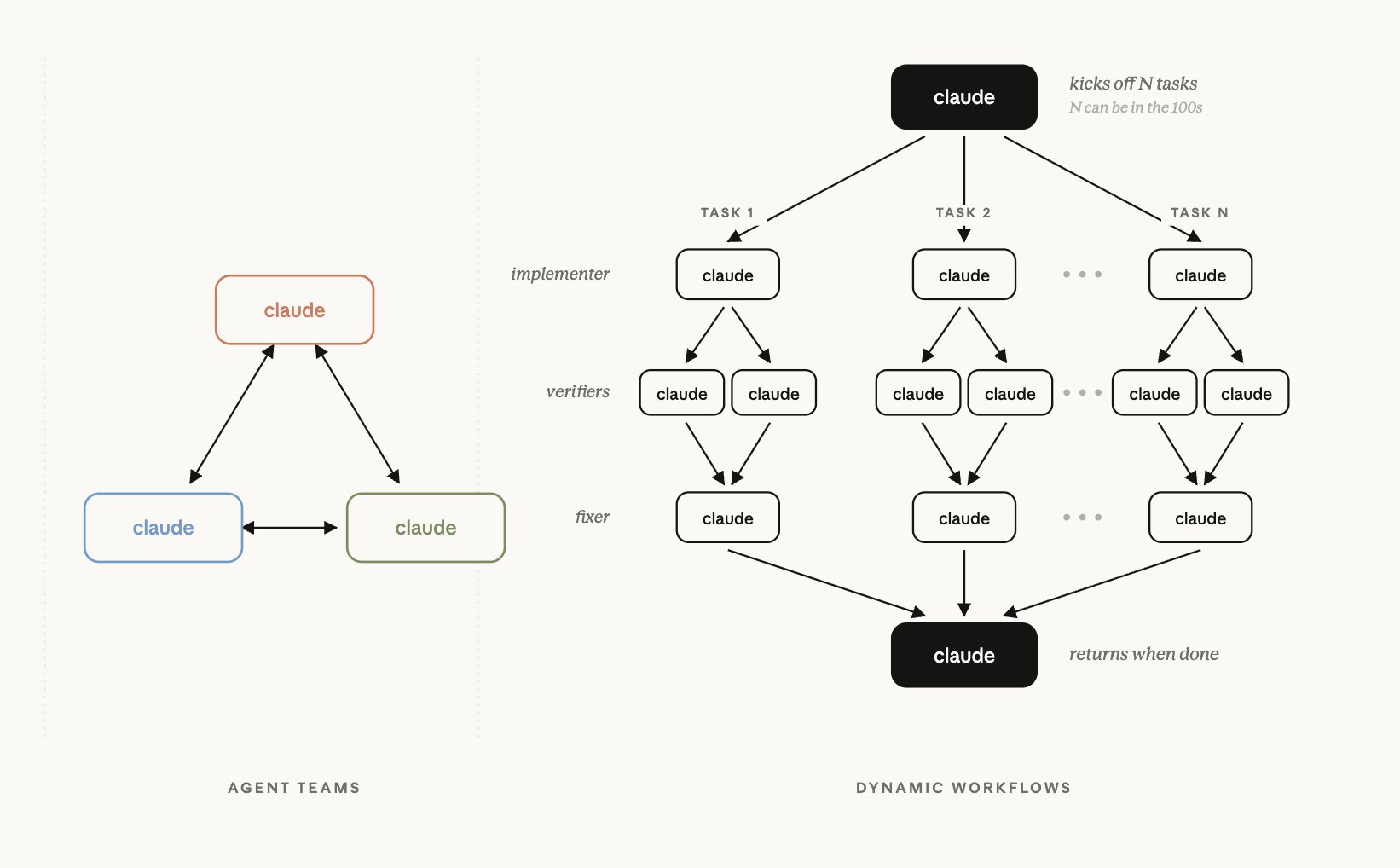
- Migrations
- Refactors
- Perf optimization
- Batch bug fixes
- Catalogue-and-categorize sweeps (A/B flags, feature toggles, dependencies, dead code, stale endpoints)
xhigh = Claude actually walking off and finishing.
This connects the arc from Part 11 (auto mode, effort mastery) through Part 12 (agent view, /goal) into Part 13: the model is more honest about its progress (Tip 1), spends more reasoning by default (Tip 2), and now has a first-class execution mode for jobs that don't fit in one pass. The autonomous fleet from Part 12's intro — agent view + /goal + worktrees — gets a fourth pillar.
Research preview. Expect the surface to change.
View Boris's dynamic workflows post View Cat's dynamic workflows threadA Harness for Every Task
Part 13 announced dynamic workflows at launch. A week later, Thariq Shihipar and Sid Bidasaria — the engineers who built the feature — published the practitioner's guide: how workflows actually work, the patterns Claude composes, and where they pay off (often on non-coding work). "Claude can now write its own harness on the fly, custom-built for the task at hand." This is the how-to behind the launch note. Best practices are still developing, and workflows often use more tokens — so think about when to reach for one.
@trq212 + @sidbid's article · June 2026The default Claude Code harness plans and executes in one context window. For most coding tasks that's highly effective. It breaks down on the long-running, massively parallel, or adversarial tasks — and the longer Claude works in a single window, the more three specific failure modes creep in.
A dynamic workflow is a JavaScript file with a few special functions that spawn and coordinate subagents. Standard JSON, Math, and Array are there too for processing data.
parallel([ fns ])— fan out, run at once. A barrier: it waits for all of them, then you have every result together.pipeline(items, ...stages)— each item streams through every stage independently. No barrier: item A can be in stage 3 while item B is still in stage 1.
claude -p. Because a static workflow has to handle every edge case, it ends up generic: "turn this into 5 web searches → fetch → verify → summarize → a generic report." With Opus 4.8, Claude is smart enough to write a custom harness tailor-made for your case: "read our billing code → check each feature against the new provider's docs → devil's advocate the strongest case against migrating → a specific recommendation."
Building a mental model for these helps you nudge Claude via prompts. They're not exclusive — Claude mixes and nests them.
Thariq: "I've found that workflows are sometimes even more useful for non-technical work." A sampling from the article:
/deep-research skill is itself a workflow: fan out web searches, fetch sources, adversarially verify their claims, synthesize a cited report. The inverse is deep verification — one agent extracts every factual claim from a report, a subagent checks each in detail, and an optional source-auditor agent confirms the source is high quality. "Verify every technical claim in my blog draft against the codebase — I don't want to ship anything wrong."
- Triage at scale: classify each backlog item, dedupe against what's already tracked, then fix or escalate. Use a quarantine pattern — agents reading untrusted public content can't take high-privilege actions. Pair with
/loopto run continuously. - Exploration & taste: for design or naming, give a review agent a rubric; the task is done when the rubric is met. Order options via tournament.
- Evals: spin agents in worktrees, then comparison agents grade outputs against a rubric — handy for refining a skill you're building.
- Model routing: a classifier researches the task, then routes to Sonnet or Opus based on expected complexity.
Workflows compose with the rest of Claude Code. Three levers worth knowing, plus the honest "when not to."
/loop to run at regular intervals and /goal to set a hard completion requirement. This is the Part 12 + Part 13 arc closing: /goal sets the exit condition, the workflow does the parallel work, /loop keeps it going.
/usage for a breakdown of the specific skills, MCPs, and plugins spending your tokens. Boris points people here first when they hit limits mid-run — it's how you find the workflow or MCP that's quietly dominating the bill.
A good workflow is reusable. Once Claude builds one you like, keep it.
~/.claude/workflows, or distribute them via a skill.
SKILL.md. For flexibility, prompt Claude to treat the workflows in a skill as a template, not a script to run verbatim — so it adapts the harness to the specific case instead of replaying it blindly.
This is the fourth pillar settling into place: Part 11's auto mode, Part 12's agent view + /goal, Part 13's Opus 4.8 + the workflow launch, and now the patterns to drive them. Thariq's closing line is the honest one — "there's still much to discover in how to use them best."
Research preview. Best practices are still developing.
Thariq + Sid's article — also on the Claude BlogReflecting on a Year of Claude Code
One year after Claude Code went GA, Boris Cherny (Head of Claude Code) and Cat Wu (Head of Product) sat down to talk about what changed — "from a Slack demo that got two reactions to engineering teams deploying it across entire codebases." Four ideas stood out, and a couple quietly overturned earlier advice on this very site: why Boris dropped plan mode, the shift to context minimalism, the one habit that lets Claude run for hours, and why auto mode is safer than reading every prompt.
@bcherny + @_catwu · June 8, 2026 Watch: "Reflecting on a year of Claude Code"For over a year, plan mode was Boris's go-to for synchronous coding. A year after GA, he's moved on — and the reason is the model, not the feature.
"From context engineering to context minimalism" is its own chapter in the interview. The era you're in tracks the model you're using.
Boris calls this the single most important idea for long-running work — and it's the whole reason his agents can run for hours.
Pairs with Part 1's CLAUDE.md and Skills tips, and Part 10's /rewind over correcting.
Auto mode routes each action to a classifier instead of asking you to approve every prompt. The interview explains why you can trust it — and why it's arguably safer than reading every prompt yourself.
Agents That Spawn Agents
A June 9 ship: nested subagent support — "agents kicking off agents as a way to better manage context," capped at depth=5 to start. Plus an experimental fork: true skill frontmatter, and a correction to how you trigger a dynamic workflow (it's "use a workflow" now, not bare "workflow"). Three quick ones, straight from Boris's thread.
Boris: "Just landed nested subagent support in Claude Code. Starting to experiment more with agents kicking off agents as a way to better manage context. Capped at depth=5 to start."
Where a dynamic workflow (Parts 13–14) is an orchestrated harness, nested subagents are the lower-level primitive — any agent can delegate to keep its own context clean. Pairs with Part 1's subagents + worktrees and Part 12's agent view.
Boris's nested-subagents threadAn idea Boris shared in the same thread, framed explicitly as "one idea I'm experimenting with" — so treat it as a preview, not a stable API.
fork: true to a skill's frontmatter so the skill runs in its own context window, then have the skill use agents to keep context isolated per step.
A correction to the activation trigger from Part 13 and Part 14. The launch said the bare word "workflow" in a prompt was the trigger. Boris has refined it:
Fable 5 — The Best Coding Model, By a Wide Margin
Anthropic launched Claude Fable 5 — a "Mythos-class model we've made safe for general use," whose "capabilities exceed those of any model we've ever made generally available." Now in Claude Code and Cowork. Boris: "the best model I have used for coding, by a wide margin… a big step up." Anthropic published a full benchmark table too — Fable 5 is state-of-the-art on nearly all of them. It's priced at $10/M in · $50/M out — double Opus 4.8. Fable-specific effort/usage tactics are still emerging.
@bcherny + @claudeai · June 9, 2026The announcement from Claude: "Introducing Claude Fable 5: a Mythos-class model that we've made safe for general use. Its capabilities exceed those of any model we've ever made generally available." Available now in Claude Code and Cowork.
The step-ups, at a glance
- Fewer prompts & steers
- More efficient token use
- Better code quality & tool use
- More intelligent self-verification
- Longer-running sessions
- Higher trust & autonomy
- Agentic coding, SWE-Bench Pro: 80.3% → 69.2 → 58.6 → 54.2
- Frontier coding, FrontierCode/Diamond (xhigh): 29.3% → 13.4 → 5.7 → —
- Knowledge work, GDPval-AA: 1932 → 1890 → 1769 → 1314
- Spatial reasoning, Blueprint-Bench 2: 38.6% → 14.5 → 36.2 → 26.5
- Computer use, OSWorld-Verified: 85.0% → 83.4 → 78.7 → 76.2
Accuracy note: "Fable 5" is the Mythos-class model made safe for general use; the table reports the higher of Mythos 5 / Fable 5 (within 1–3 pts). On the starred benchmarks (cybersecurity, biology, Terminal-Bench, Humanity's Last Exam, HealthBench), Fable 5 performs closer to Opus 4.8 due to safety fallbacks — so treat those higher figures as Mythos 5. Boris confirms the classifiers are currently "trigger-happy" (flagging ordinary debugging as cyber/bio) and the team is "working on improving it."
Fable 5 supersedes Opus 4.8 as the strongest coding model — which shifts a couple of earlier tips and leans harder into others.
/goal (Part 12), nested subagents (Part 16), and workflows (Parts 13–14) all benefit from a base model that self-verifies better and needs less babysitting.
claude-fable-5; 1M context, 128K max output, adaptive thinking, knowledge cutoff Jan 2026; no fast mode yet. Fable-specific effort levels and usage best-practices aren't documented yet.
Finding Your Unknowns — The Map Is Not the Territory
Thariq (@trq212, Claude Code) says working with Fable 5 keeps re-teaching one lesson: "the map is not the territory." The map is what you give Claude — your prompts, skills, and context. The territory is where the work actually happens — the codebase, the real world, its actual constraints. The gap between them is what he calls your unknowns. Fable is the first model where he finds the quality of the work is bottlenecked by his ability to clarify those unknowns — so "reducing and planning for your unknowns is the skill of agentic coding." The good news: it's a skill you can improve at, by working with Claude.
@trq212 · July 3, 2026When Thariq brings a problem to Claude, he breaks it down four ways — the Rumsfeld matrix, applied to prompting:
When Claude hits an unknown, it has to make a decision based on its best guess of what you want. "The best agentic coders have relatively few unknowns," Thariq writes — watching someone like Boris or Jarred prompt, it's obvious they know what they want in detail and are deeply in-sync with both the codebase and the model's behaviors. But they also assume unknowns. Reducing and planning for them is the actual skill of agentic coding — and the rest of this Part is his toolkit for finding them before, during, and after implementation.
A Field Guide to Fable: Finding Your UnknownsMost unknowns are cheapest to find before you write code. Thariq's pre-implementation techniques, each with the literal prompts he uses:
No matter how much you plan, there are always unknown unknowns lurking — the agent may hit an edge case mid-work that forces a different tack.
implementation-notes.md (or .html) file where it logs the decisions it makes, so you can learn from them on the next attempt.
This pairs with Part 15's "write it down" discipline — what the agent learns mid-run becomes the map for next time, instead of evaporating when the session ends.
A Field Guide to Fable: Finding Your UnknownsOnce the work lands, the remaining unknowns are other people's — your reviewers' and your own future understanding.
Getting Started With Loops
The Claude Code team defines a loop as an agent repeating cycles of work until a stop condition is met. Everything from a single prompt to a cloud routine is a loop — they differ only in how they're triggered, how they're stopped, which Claude Code primitive runs them, and what kind of task fits. This guide maps the four types and when to reach for each. Not every task needs a complex loop — start with the simplest one and use these patterns selectively.
@ClaudeDevs · July 6, 2026Every loop in Claude Code fits one of four shapes. They differ by what triggers them, what stops them, and — most usefully — how much of the loop you hand off:
Notice the progression: moving from turn-based to proactive, you hand off more of the loop each step — first the verification check, then the stop condition, then the trigger, and finally the prompt itself. Tab 4 has the full "which loop when" table.
Getting started with loopsThe two real-time loops: you kick them off and stay close.
SKILL.md so Claude verifies its own work end-to-end, and give it tools to see, measure, interact (the more quantitative the check, the easier it self-verifies). Builds on verification and Part 18's verification skills.
/goal lets you define what "done" looks like so Claude can't quietly decide it's "good enough" and stop early. Each time it tries to stop, an evaluator model checks your condition and sends it back to work until the goal is met or your turn cap is reached. Deterministic criteria — tests passing, a score threshold — work best. Extends /goal (see Part 12).
The two autonomous loops: the work comes to Claude instead of you prompting each time.
/loop re-runs a prompt on an interval on your machine — turn your laptop off and it stops. Move it to the cloud by turning it into a Routine with /schedule. Pulls together /loop, /schedule, and Routines.
/schedule to watch for new work, /goal + verification skills to define and check "done," dynamic workflows to orchestrate triage/fix/review across many items, and auto mode so it never stops to ask permission. Each task exits at its goal; the routine runs until you turn it off.
A loop is only as good as the system around it. Two things to get right, plus a cheat sheet.
- Keep the codebase clean — Claude follows the patterns already there.
- Give it a way to verify its own work — encode what "good" looks like as skills.
- Make docs easy to reach — framework and library docs carry current best practices.
- Use a second agent for review — fresh context is less biased; the built-in
/code-reviewor Code Review for GitHub.
- Right primitive + model — small tasks don't need a fleet; use cheaper/faster models for routine work.
- Clear stop criteria — specific "done" so Claude lands sooner (but not too soon).
- Pilot before a large run — dynamic workflows can spawn hundreds of agents; gauge on a slice first.
- Scripts for deterministic work — running a script beats re-reasoning the steps each time.
- Don't over-schedule — match the interval to how often the thing you watch actually changes.
- Review usage —
/usagebreaks down skills/subagents/MCPs;/goalwith no args shows turns + tokens so far;/workflowsshows per-agent usage and lets you stop one.
| Loop | You hand off | Use it when | Reach for |
|---|---|---|---|
| Turn-based | The check | You're exploring or deciding | Custom verification skills |
| Goal-based | The stop condition | You know what done looks like | /goal |
| Time-based | The trigger | The work happens on a schedule, outside your project | /loop, /schedule |
| Proactive | The prompt | The work is recurring and well-defined | All of the above + dynamic workflows |
To get started, look at the work you already do, pick one task where you're the bottleneck, and ask which piece you could hand off — the verification check, the stop condition, or the trigger. Run the loop, watch where it stalls or over-reaches, and iterate.
Getting started with loopsGive Your Setup a /checkup
Every setup drifts — skills you stopped using, a CLAUDE.md that quietly grew to 10k tokens, hooks that slow every turn, a version that's three releases behind. Boris shipped /checkup: one command that audits your whole Claude Code install, tells you exactly what's wasteful or broken, and cleans it up — after it confirms with you, and always reversibly. It's the whole "keep your setup lean" playbook — context minimalism, CLAUDE.md hygiene, writing fixes down instead of re-prompting — turned into a single command.
@bcherny · July 8, 2026Run /checkup and Claude Code inspects your setup for waste, staleness, and breakage, then proposes fixes across seven areas:
- Clean up unused skills / MCPs / plugins — drop what you never invoke and save context every session (context minimalism).
- Dedup your local CLAUDE.md against the checked-in one so rules aren't stated twice.
- Break up a big root CLAUDE.md into nested CLAUDE.md's + skills, so context loads only where it's relevant.
- Turn off slow hooks that tax every turn.
- Update Claude Code to the latest version.
- Enable auto mode by default so it stops asking permission for safe work.
- Pre-approve frequently-denied read-only commands — the same idea as
/fewer-permission-prompts.
The reason you can run /checkup on a real project without holding your breath: it never changes anything behind your back.
/checkup surfaces a plan first — here's what's broken, here's what's unused, here's what it'd change — and waits for your call. Nothing is modified until you pick an option.
git diff before you commit a thing — same discipline as writing fixes down instead of re-prompting.
- Clean up everything — the recommended one-shot.
- Let me pick — choose which groups to touch (install repair, unused plugins/MCP, unused skills, CLAUDE.md slimming).
- No, keep everything — report only; nothing changes.
- Chat about this — ask questions before deciding.
Boris ran /checkup on his own setup and posted the result. It caught things he didn't know were there:
- His
claudecommand was broken — a test run had overwritten its launcher. - 38 project skills had never been used across 2,345 sessions.
- His CLAUDE.md was loading ~10k tokens every session.
git diff review.
The lesson underneath the feature: setups accumulate silent waste, and you rarely notice until something measures it. /checkup is that measurement — the maintenance half of context minimalism, automated.
Automation Is the Meta-Skill
The best engineers always spent their time automating — vim macros, lint rules, e2e suites — because it multiplied their own output. Boris argues that in the agent era this matters more, for three reasons: it speeds up your whole fleet, it moves fixes into code so a class of bug is gone forever, and — most importantly — it lets anyone contribute by encoding domain knowledge as infrastructure instead of leaving it stuck in people's heads. The punchline: a rejected PR is a failure of automation.
@bcherny · July 15, 2026The through-line hasn't changed — only gotten stronger. The best engineers Boris knew always poured time into automating their own work, because it multiplied everything else they did.
Infra and DevX automation speeds you up — and if you're running an army of agents, every one of them is sped up too. So the payoff stopped being linear:
Pairs with parallel execution (Part 1) and loops (Part 19).
Boris on automation as leverageThere's a difference between fixing an issue and eliminating a class of issue. The first is a chat correction; the second is infrastructure.
Boris: this is "really what people are talking about when they talk about loops — it's about automating entire types of busywork rather than solving them one off." Not a new idea — engineers have done it for a long time — but agents make it cheap to reach for. It generalizes write it down, don't re-prompt (Part 15): a chat correction fixes one run; encoded infrastructure fixes every run (Part 19).
Boris on moving fixes into codeThe most important reason, and the one that's genuinely new. Automation is what lets other people — not just you — contribute to a codebase.
What's changed: the knowledge you can encode as infrastructure is no longer limited to lint rules, types, and tests. It can now capture nearly all domain knowledge —
— so an agent (or a new human) works productively with zero additional context from the prompter. Builds directly on CLAUDE.md (Part 1), skills (Part 2), and code review (Part 6).
Every team should be writing the CLAUDE.md's, REVIEW.md's, skills, and docs that let agents work in their codebase with zero extra context. It sounds extreme, but it's the natural extension of what engineers have always done: automate, and encode domain knowledge as infrastructure — so Claude writes better code, review catches issues automatically, and the next person contributes more easily.
Boris on encoding domain knowledgeThe New Rules of Context Engineering
Your prompt is only a sliver of what Claude actually reads — the rest is assembled from the system prompt, CLAUDE.md, skills, memory, and references. That's context engineering, and the rules just changed. Tuning Claude Code for the Claude 5 generation, the team deleted over 80% of the system prompt with no measurable loss on coding evals. Thariq distilled what they learned into six then→now shifts, and every one says the same thing: stop over-constraining the model and let its judgement do the work. It lands the same day as Opus 5 — the model these rules are written for.
@trq212 · July 24, 2026The headline shift. Older models needed rigid guardrails to avoid worst-case behavior — but a rule that's right 90% of the time is wrong the other 10%. Newer models read the surrounding context and decide for themselves, so the team swapped hard rules for judgement. The system prompt's comment guidance is the cleanest example:
The rule was wrong everywhere comments were wanted — documentation, gnarly code. Judgement handles both cases without a special rule for each. That's how they cut the prompt so hard:
The mirror worth holding up: most CLAUDE.md files (this repo's included) are still walls of hard rules and banned phrases. Updates context minimalism (Part 15).
The new rules of context engineeringThe old number-one rule for tools was to give Claude worked examples. With the newest models, examples backfire — they fence Claude into the exploration space you happened to demonstrate. Design the interface instead, and let expressive parameters do the teaching.
The enum hints at the lifecycle; the "one in_progress" rule pins down the behavior — no example needed. Ask the same of your own tools, scripts, and files: what parameters does Claude have, and how could they be more expressive? A rich interface beats a page of examples. (Same idea for design: an HTML mockup beats a described layout or a screenshot — see tab 4.)
The new rules of context engineeringDon't cram everything a request might need into the prompt. Load context at the moment it's relevant — the same principle whether it's the built-in system prompt, tools, or your own files.
| Surface | Then — all upfront | Now — loaded when needed |
|---|---|---|
| System prompt | Code-review & verification steps baked in | Moved into skills Claude calls selectively |
| Tools | Every definition always in context | Deferred loading — searched via ToolSearch before use |
| CLAUDE.md / skills | One mega-file with every practice | A tree of files loaded at the right time |
The myth is that CLAUDE.md and skills should be a central repository for everything you might hit, because Claude won't find it otherwise. It will. Split long skills across many files and let Claude pull the branch it needs.
Two shifts in how Claude remembers, and what you point it at.
# hotkey. Now Claude automatically saves memories relevant to the work and to you, and loads them across sessions — memory, artifacts, and skills take over the job CLAUDE.md used to do alone. Builds on auto-memory (Part 8) and write-it-down (Part 15).
And references got richer. A "spec" no longer means a markdown file — Claude handles far more expressive references, and code-shaped ones carry the highest fidelity:
Pull it together — here's the stack Claude assembles for a request, top to bottom, and what belongs in each layer:
- Your prompt — the one specific thing you want right now.
- References — @-mentioned files, specs, mockups, codebases, artifacts.
- System prompt — tied to the product; you rarely touch it in Claude Code (spend real time here only if you're building your own agent).
- CLAUDE.md — lightweight: what the repo is for, and the gotchas. Skip the obvious; push detail into skills via progressive disclosure.
- Skills — lightweight guides for your opinions and best practices; avoid over-constraining except in high-stakes areas.
- Memory — now automatic.
claude doctor command (/doctor in Claude Code) rightsizes your skills and CLAUDE.md automatically — the context-engineering twin of Part 20's /checkup.
These rules ship for a reason. Opus 5 landed the same day — state-of-the-art on coding and knowledge-work evals (agentic terminal coding, GDPval, ARC-AGI-3, computer use). But the eval scores aren't what Boris led with.
That's the ground the new rules stand on: judgement-based context engineering only works if you can trust the model to reconcile conflicting, attacker-adjacent context safely. Pairs with why auto mode is trustworthy (Part 15).
Claude Maintains the Apps
Part 21 argued that moving fixes out of prompts and into routines is the highest-leverage thing an engineer can do. This is the receipt. For a few weeks Boris has had Claude take over day-to-day maintenance of Anthropic's apps — a Slack channel, a dozen daily routines, and no one driving. The result: 388 PRs opened, 180 merged across iOS, Android, Desktop, web, CLI, and the Agent SDK. The interesting part isn't that it works. It's the specific list of jobs worth handing over, and the operating habits that keep the output mergeable.
@bcherny · August 13, 2026Every guide tells you to set up routines. Almost none tell you what to point them at. Boris published his list — the daily jobs running against Anthropic's own apps — and it's the most concrete answer anyone has given:
| Routine | What it does |
|---|---|
| Crash fuzzer | Finds real-app crashes and opens root-cause fixes |
| Ant-only shipper | Ships or deletes forgotten internal-only features based on usage |
| Logic simplifier | Simplifies convoluted business logic |
| Logic bugfixer | Models tricky logic to find and fix bugs |
| Dup unifier | Merges duplicated implementations into one |
| Dead-code removal | Deletes provably unreachable code |
| Useless-test pruner | Deletes tests that can't fail |
| Shipped-feature inliner | Removes flags for fully shipped features |
| Flaky-test fixer | Root-causes flaky CI tests |
| Abstraction improver | Flattens over-engineered abstractions |
| Abstraction police | Fixes layering violations |
Notice what they have in common: every one is mechanical, verifiable, and endless — the maintenance you keep meaning to get to. None of them are feature work. Each runs as a separate routine per app, across every surface:
Output lands in one Slack channel, proj-claude-maintains-apps, with a top-level thread per routine so a dozen parallel jobs stay readable. Picks up where Part 10 (Routines) and Part 21 (automation as infrastructure) left off.
The dead-code routine is the cleverest thing in the thread, and it's easy to miss. Static analysis only proves the easy half — code nothing references. The code that's reachable but never actually runs is the stuff that accumulates for years, and no analyzer can tell you it's safe to cut. So the routine doesn't guess. It splits the job across two days.
Day one gathers evidence; day two acts on it. That's a shape worth stealing beyond dead code — any time a routine needs a fact it can't derive from a static read, have it instrument the codebase and read its own results on the next run. A routine that runs daily can afford to be patient.
The whole thing was requested in eight words:
The two-phase design wasn't specified. Claude worked out that a probe was needed — which is what Part 22's "give judgement, not rules" looks like in production.
Claude takes over day-to-day maintenanceAn autonomous routine opening PRs all day is only useful if reviewing each one is cheap. Boris solved that by demanding evidence in the prompt itself — every PR arrives carrying its own proof:
And for the logic routines, the bar goes further — model the behavior formally before touching it:
A truth table turns "trust me, this refactor is equivalent" into something a reviewer checks in seconds. It also does quiet double duty: enumerating the cases is how the routine finds the gaps and duplication it's supposed to fix. The verification artifact and the discovery method are the same work.
Also in the prompt: run the real apps, no mocks. A crash fuzzer against a mock finds mock bugs. Extends the verification-as-a-skill idea from Part 19.
Claude takes over day-to-day maintenanceThe habit that makes the whole system compound. When a PR comes back wrong, the instinct is to fix the PR. Boris fixes the routine instead, and lets tomorrow's run produce a better PR on its own.
The corollary is a patience most people don't budget for. A routine isn't right on day one, and that's not a failure signal:
Note who does the tuning. He doesn't rewrite the prompt himself — he asks Claude to tune its own routine. The routine is the artifact under development, and the daily cadence is its feedback loop. Judge a routine on its trend across a week, not its first PR.
Claude takes over day-to-day maintenanceThe number worth carrying around, because it sets expectations honestly. Over a few weeks of daily routines across six surfaces:
Not 95%, and not 10%. Roughly half of autonomous maintenance work is good enough to keep — which is an excellent return on code nobody was going to write, and a terrible return if you were planning to merge on trust. Nothing lands unreviewed:
Which locates the real bottleneck. With generation nearly free, the constraint moves to review throughput — and that's exactly where Boris says the work is heading next: "We're now thinking about how to streamline this to make merging these kinds of mechanical changes easier." The routines aren't the hard part anymore. Merging is.
To try it: ask Claude Code or Tag to set one up, or create routines directly at claude.ai/code/routines. Start with one routine on one repo — the eleven above took weeks of tuning to reach 46%.
Claude takes over day-to-day maintenanceThe Diff Pane, and Who Maintains It
/diff stopped being a one-shot list and became a panel that stays open, scrolls, and updates live. The replies under the release covered three more things: which diffs Boris reads and which he skips, what to do when the terminal jumps or flickers, and how the library that draws the whole interface gets maintained. Claude has rewritten Ink multiple times, and the team runs it behind property-based tests without reading the implementation.
/diff already existed. In this release it stopped closing after you read it:
A one-shot list of uncommitted changes. You pick a file, read it, and press Esc to close.
A persistent pane beside the conversation. Scroll it, click into files, and it updates in real time as Claude writes.
What Boris says it's for:
Reviewing agent output used to mean switching to another window and back. Two related answers came out of the same thread:
When someone asked for a way to switch off the inline file-write diffs that fill the transcript, Boris's whole reply was /focus. It does a different job from /diff: one gives you somewhere to read changes, the other stops them appearing inline as Claude works.
Claude Desktop already had a diff viewer, so this release brings the terminal in line with it.
Someone asked under the release: "If coding was solved, then why do we need to read the code?" Boris answered with the two conditions that get him to open a diff:
He doesn't say which code meets either bar — that judgement stays with you. The second sentence of his reply carries as much as the first:
The agent writes the code now. Choosing which of its changes to read is still your job, and that's the work you're doing when you open the pane.
Why read the code at allA user mentioned their TUI jumps around and flickers. Boris treated it as a bug report:
Boris's fix, in the order he gave it:
Boris's first step.
If updating doesn't fix it.
TUI shouldn't be jumping around or flickeringSomeone asked how Claude Code handles scrollable views in Ink, the React-for-terminals library that draws the entire interface:
Claude has rewritten the rendering layer of Claude Code repeatedly, and the person who created Claude Code does not know how the current version works. What he names in place of reading it:
Property-based tests assert rules that must hold across many generated inputs, rather than checking specific cases a person wrote out. Boris doesn't say which properties Ink's suite asserts, only that there are "a ton" of them alongside benchmarks.
You can hand over a component once the tests specify it well enough that you never need to read it. Writing those tests is the part that stays with you. Part 23 (Claude maintaining the apps) and Part 21 (encode knowledge as infrastructure) describe the same move at a larger scale.
One reply in the thread called it "both an engineering flex and mildly terrifying." Which one it is depends on how good the tests are.
Claude has re-written Ink multiple timesSpending Your Effort
Thariq got a lot of questions from users about what /effort really is and when to use which level. So he ran the same tasks at different effort levels on Opus 5.5 and dug into the Terminal-Bench 3.0 results. What he found: effort changes how much verification and edge-case testing Claude does, and how much of its own judgement it uses. Low and medium were perfect for getting things done quickly and staying in the loop. Extra effort gave better results on hardware, code review, and security.
The article and a follow-up reply link a version with interactive diagrams on claude.dev.
Thariq's definition: effort gives the model "an approximation of how much compute you want it to spend on the task." His analogy is a time budget handed to a person:
| Asked to do it in | What you'd do |
|---|---|
| 12 hours straight | Assume they just want you to do it and try very hard |
| 1 hour | Get them the best version that meets their task, then expect to iterate from there |
| Or push back | Say the task needs at least 3 hours, then work 3 hours to deliver it |
Switching levels keeps the cache. He says the newest models respond to effort "without breaking the prompt cache in Claude Code," and suggests varying it by task "or even mid-conversation."
He calls Fable 5.1 and Opus 5.5's effort curves "our best yet." On his Terminal-Bench 3.0 chart, each step up in effort raises both the pass rate and the tokens spent, and one annotation links Opus 5.5 at high to Fable 5.1 at max:
Thariq's rule of thumb, from the card he published with the article:
In a reply under the article:
His rule of thumb names four levels; xhigh isn't one of them, though his benchmark runs include it. Part 11 recorded Boris using xhigh "for most tasks" on Opus 4.7; Thariq's rule for Opus 5.5 and Fable 5.1 puts regular feature work at medium.
When to use different effort levels in Claude CodeThariq gave Opus 5.5 the same underspecified prompt at each level: "build a personal fitness and workout tracker app." Effort changed how fleshed out the app was, "but also results in Claude making more choices along the way."
"Just a log and a simple graph." A simple base to iterate from.
More complex, with additional detail and a heat chart. "Claude's best one shot."
Redesigning Claude Code's /config menu went the same way. Every pass had roughly the same idea, submenus and better search. Low (1 minute) gave an interactive sketch that didn't look much like Claude Code. Max (28 minutes) gave a mockup that did, plus walkthroughs for different flows. For that task he preferred low, "to understand Claude's vision."
When Claude interviewed him in depth first and different models built from that spec, "the models behaved much more similarly": fairly similar designs and implementations, with different details. The runs he shows took 16, 22, 33 and 79 minutes from low to max.
"A particularly fruitful loop for feature development I've been using is":
| Step | Detail | Effort |
|---|---|---|
| 1. Interview | Give Claude a spec and ask it to interview you about any details you're missing | — |
| 2. Implement | Implement it | low |
| 3. Review | Make sure it got the gist of it correct; iterate as needed | low |
| 4. Verify | Verify and test | high |
The article's opening describes the same loop for normal software engineering, with implementation "on low/medium effort." Each level sits where the rest of the article found it useful: low keeps you in the loop while you check the gist, and high is where verification and edge-case testing pay off.
For tasks where effort decides whether Claude finishes at all, Thariq went to Terminal-Bench 3.0, a community-sourced benchmark. His main takeaway:
His clean example is html-js-filter, an HTML sanitizer that strips every way of smuggling JavaScript into a page. Fable 5.1 went from 1/5 at low to 5/5 at xhigh. A typical low attempt (about 2 minutes) wrote a filter in roughly one pass and tested it against a single hand-written page. The high run he traced (about 33 minutes) did this:
His failure-breakdown chart compares Fable 5.1 at low and at max, 370 attempts each (median 73k vs 222k tokens each):
| Outcome | Low | Max |
|---|---|---|
| Passed | 140 | 214 |
| Missed a case | 59 | 24 |
| Made the wrong call | 133 | 107 |
| Other failures | 38 | 25 |
His reading: more effort "tends to reduce failures due to missing edgecases … but does not fix when the model has the wrong approach." Inside "made the wrong call," one row on the chart goes the other way: picked the wrong reading rises from 25 to 47. The article doesn't discuss it.
"But you don't need this level of effort for every task."
Higher effort levels help when there are many edge casesSome Terminal-Bench 3.0 problem areas benefited from effort more than others. Pass rate for Fable 5.1, low effort → top effort, from Thariq's chart:
| Area | Tasks | Low → top |
|---|---|---|
| Security | 7 | 64% → 87% |
| Hardware | 5 | 34% → 75% |
| ML | 13 | 54% → 73% |
| Science | 15 | 41% → 61% |
| Software | 20 | 43% → 56% |
| Media | 4 | 18% → 30% |
| Operations | 10 | 12% → 22% |
The chart's note on Operations: "Rulebook-style work stays low." Its percentage column isn't labeled with a model; the numbers line up with Fable 5.1's plotted points.
He then picked three tasks where Opus 5.5 failed at low and succeeded at high, "mostly because it tested and accounted for edge cases":
mvcc-lsm-compaction (0/5 → 4/5 at xhigh): at low, Claude edited the code before building it or running the reproducer. At xhigh, it reproduced the crash first, wrote a randomized test against a reference that never compacts, and checked its tests failed on half-finished fixes.
cli-2ph-simple (0/5 → 5/5 at high): at low, one pass, a few small test problems, and a warning it might be slow on big problems that it never checked. At high, it tested against a separate brute-force solver, timed bigger problems, and reworked its search.
gsea-proteomics (0/5 → 4/5 at high): at low, one reasonable-sounding way to prep the data. At high, it tried two, noticed the list of significant treatments changed, and dug into why before choosing.
How To Use Skills
Anthropic runs hundreds of skills internally. Thariq cataloged what works, what doesn't, and how to think about building them. 9 skill types, 9 authoring tips, and distribution strategies from production use. We turned his post into a skill. Obviously.
@trq212's March 17, 2026 postGet the full guide available directly in Claude Code. Type /thariq-skills anytime to surface it.
Covers all 9 skill types, authoring best practices, progressive disclosure patterns, distribution strategies, and the gotchas Anthropic discovered running hundreds of skills in production.
Once installed, the skill checks for a newer version each time you type /thariq-skills and updates itself. Re-run the command above anytime to update manually. To uninstall: rm -rf ~/.claude/skills/thariq-skills/
After cataloging all their skills, Anthropic noticed they cluster into recurring categories. The best skills fit cleanly into one.
Internal libs, CLIs, SDKs, gotchas
billing-lib · platform-cli
Drive the running product to verify
signup-driver · checkout
IDs, field names, query patterns
funnel-query · grafana
Multi-tool workflows → one command
standup · weekly-recap
Framework-correct boilerplate
new-app · migration
Adversarial review, style, testing
adversarial · hypothesis
Commit, push, deploy safely
babysit-pr · deploy
Symptom → investigation → report
oncall · log-correlator
Safety-gated cleanup & maintenance
orphans · cost-investigation
The best practices from running hundreds of skills in production.
Install as a Claude Code Skill
Get all 142 tips available directly in Claude Code. Type /boris anytime to surface these workflow patterns.
A skill is a knowledge file that lives on your machine. Once installed, Claude references it automatically when you ask about workflows — or on demand with /boris.
Safe to run: it just saves one plain-text markdown file — no code executes on install. Read exactly what it does first: inspect the file, or ask Claude to check it before you install.
npm install -g @anthropic-ai/claude-code
Run this command in your terminal to install globally:
This installs globally to ~/.claude/skills/. For project-specific install, use .claude/skills/ instead.
Start a new Claude Code session and type:
You'll see the full tips document appear in your conversation. If you get "skill not found", verify the file exists: ls ~/.claude/skills/boris/SKILL.md
- Parallel Execution - Worktrees, multiple sessions, web/mobile
- Model Selection - Why Opus 4.5 with thinking
- Plan Mode - Start complex tasks right
- CLAUDE.md - Best practices, @.claude in PRs
- Skills & Commands - /simplify, /batch, /btw, custom workflows
- Subagents - Common PR automations
- Hooks - PostToolUse, SessionStart, PermissionRequest, Stop
- Permissions - Pre-allow safe commands, wildcard syntax
- MCP Integrations - Slack, BigQuery, Sentry
- Prompting - Challenge Claude, write specs
- Terminal Setup - Ghostty, /voice, /color, keybindings
- Bug Fixing - Slack MCP, CI tests, docker logs
- Long-Running Tasks - Stop hooks, background agents
- Verification - Chrome extension, browser testing
- Learning - Use Claude to understand code
- Customization - Themes, spinners, output styles
- Plugins & Agents - LSPs, MCPs, --agent, custom agents
- Safety - Sandboxing, auto mode, permissions
- Worktrees - claude -w, Desktop, subagent isolation, non-git VCS
- Scheduled Tasks - /loop, /schedule, automated workflows
- Code Review - Agent-powered PR reviews that catch real bugs
- /effort - Max reasoning mode for deeper thinking
- Remote Control - Teleport, mobile app, /remote-control
- Session Management - --name, /branch, --fork-session
- Setup Scripts - Automate cloud environment setup
- PostCompact Hook - React to context compression
- iMessage Plugin - Text Claude from any Apple device
- Auto-Memory & Dream - Persistent, self-cleaning memory
- Mobile App - Write code from the Claude iOS/Android app
- Cowork Dispatch - Remote control for Claude Desktop
- Desktop App - Auto start and test web servers
- --bare - 10x faster SDK startup
- --add-dir - Give Claude access to more folders
- Routines - Scheduled and event-driven Claude Code runs
- Rewind - Double-Esc to drop failed attempts from context
- /compact vs /clear - Know when to summarize vs start fresh
- Auto-compact window - Env var to dodge context rot at 400k
- Delegation over Guidance - Treat Opus 4.7 like an engineer you hand off to
- Full Task Context Upfront - Goal, constraints, acceptance criteria in first turn
- xhigh effort - New default reasoning level for Opus 4.7
- Auto Mode + Parallel Claudes - Run multiple sessions, zero babysitting
- /fewer-permission-prompts - Scan history, tune your allowlist
- Recaps - Know what happened while you were away
- Focus Mode - /focus to see only the final result
- /go - Verify + simplify + PR in one composite skill
- 4.6→4.7 Shifts - Calibrated length, less auto-tool-use, judicious subagents
- Notifications - Hooks and alerts for autonomous runs
- Agent View -
claude agentscontrol plane — one list of all your sessions grouped by status - /goal - Set a completion condition; Claude keeps working until it's met (Ralph loop built into Claude Code)
- Opus 4.8 - Strongest coding model yet: SWE-Bench Pro 64.3 → 69.2, more honest about its own work, catches bugs before declaring victory
- High-Effort Default + xhigh - 4.8 defaults to high effort (same tokens as 4.7, better output); switch to xhigh for hard problems; Claude Code rate limits raised to cover
- Dynamic Workflows - Research preview for tasks too big for one pass; say
use a workflowto activate the orchestrator → implementer → verifiers → fixer pattern; save for migrations, refactors, perf, batch bug fixes, catalogue-and-categorize sweeps - Workflow Failure Modes - Why workflows exist: agentic laziness, self-preferential bias, goal drift
- Workflow Primitives -
agent,parallel,pipeline, schema/model/isolation; dynamic vs static harnesses - Six Workflow Patterns - Classify-and-act, fan-out-and-synthesize, adversarial verification, generate-and-filter, tournament, loop-until-done
- Workflow Use Cases - Bun's Zig→Rust rewrite, deep research/verification, sorting 1000+ items, rule adherence, root-cause, triage
- Workflow Budgets - Cap tokens ("use 10k tokens"), pair with /goal and /loop, quick workflows, when not to use one
- Saving & Sharing Workflows - Press "s" to save, check into ~/.claude/workflows, distribute via a skill as a template
- Auto Mode Retired Plan Mode - Boris dropped plan mode for auto mode on Opus 4.6+ — newer models don't need a planning step
- Context Minimalism - Minimal system prompt + tools; let the model pull the rest (prompt eng → context eng → minimalism)
- Write It Down, Don't Re-Prompt - Every mistake → CLAUDE.md or a skill, not a chat correction
- Why Auto Mode Is Trustworthy - Thousands of transcripts classified + red-teamed into evals; safer than glazing over prompts
- Nested Subagents - Agents kick off agents (depth=5) to manage context; monitor with arrow-down in the terminal
- fork: true - Experimental skill frontmatter: run a skill in its own context window; being added to /code-review
- Workflow Trigger - Say "use a workflow" (not bare "workflow" — too many false positives)
- Fable 5 - Anthropic's "Mythos-class" model — Boris's best coding model "by a wide margin"; in Claude Code + Cowork
- What Fable 5 Changes - New default coding model (supersedes Opus 4.8); leans into context minimalism + delegation
- Finding Your Unknowns - Thariq's field guide to clarifying what Claude doesn't know — before, during, and after implementation
- Getting Started With Loops - The four loop types (turn-based, goal-based, time-based, proactive) and which to reach for when
- /checkup - One command to audit and clean up your setup: unused skills/MCPs/plugins, a bloated CLAUDE.md, slow hooks, stale version — confirms first, fully reversible
- Automation as Infrastructure - Encode domain knowledge as CLAUDE.md, REVIEW.md, skills & lint rules so agents (and new contributors) work with zero extra context — a rejected PR is a failure of automation
- New Rules of Context Engineering - The Claude 5 shifts (judgement over rules, interfaces over examples, progressive disclosure, auto-memory, rich references),
/doctorto rightsize your setup, and Opus 5 — the least prompt-injectable model yet - Claude Maintains the Apps - The eleven daily maintenance routines Boris runs (crash fuzzer, dup unifier, dead-code removal, abstraction police…), probe-then-delete, truth tables as PR evidence, tuning the routine instead of the PR, and the 388→180 merge yield
- Spending Your Effort - Thariq's guide to
/efforton Opus 5.5 and Fable 5.1: low to stay in the loop, medium for regular features, high for bugs and edge cases, max for hard hand-offs; the interview → build low → verify high loop; Terminal-Bench 3.0 data on where effort pays off
Prefer to download manually? Download SKILL.md and place it in:
Create the ~/.claude/skills/boris/ directory if it doesn't exist.
The skill automatically checks for updates when you type /boris. If a newer version is available, Claude will download it for you — no manual steps needed.
To uninstall: rm -rf ~/.claude/skills/boris/
Skills are markdown files with YAML frontmatter that Claude Code loads automatically. When you type /boris or ask about related topics, Claude surfaces this knowledge to help you. Skills can be user-invocable (slash commands) or auto-surfaced based on semantic matching.